Circular Mega-Base Layouts: Masterplanning Concentric Rings & Radial Zoning (2026)

Constructing a mega-base is the quintessential endgame milestone in Minecraft. Yet, more than 80% of survival mega-projects are abandoned before completion. The culprit isn't a lack of building blocks or time—it is poor spatial masterplanning and linear base sprawl that quickly becomes overwhelming to navigate.
A concentric circular mega-base layout eliminates base sprawl by organizing your entire world around a central high-efficiency hub, surrounded by functional radial zones and cascading architectural rings. In this 2026 architectural masterclass, we will walk through the exact mathematical ratios, radial zoning formulas, and automated storage integrations to design a mega-base that is as functional as it is breathtaking.
A completed multi-tiered oceanic mega-base planned with concentric circle foundations, copper accents, and surrounding agricultural biodomes.
Why Concentric Circles Beat Linear Mega-Bases
In standard rectangular mega-bases, traveling between your storage warehouse, villager trading hall, crop farms, and nether portal requires endless sprint-jumping down long hallways. Concentric circular layouts offer undeniable gameplay and design advantages:
- Equal Radial Travel Distance: Every essential station is equidistant from your central hub, cutting travel time by over 50%.
- Natural Phased Construction: You can build and fully finish the core ring first, then expand outward ring-by-ring without the base feeling incomplete at any stage.
- Unified Aesthetic Silhouette: Whether viewed from an Elytra dive or on an in-game map item, circular rings provide striking geometry from every angle.
1. The 1:2:3 Concentric Ring Sizing Formula
The secret to visually balanced circular mega-bases lies in proportional ring spacing. If rings are too close, buildings feel cramped; if they are too far apart, the base feels desolate. Use this proven ratio:
| Ring Zone | Recommended Diameter | Primary In-Game Purpose | Key Features |
|---|---|---|---|
| Core (Ring 1) | 31 to 41 Blocks | Central Command & Fast Storage | Multi-item sorter, automated Crafter room, central beacon spire |
| Mid-Ring (Ring 2) | 65 to 85 Blocks | Active Gameplay & Biospheres | Villager trading hall, mini automated farms, potion breweries, enchanting rotunda |
| Outer Ring (Ring 3) | 125 to 165 Blocks | Perimeter & Heavy Infrastructure | Super smelters, iron golem towers, mob drop processing, harbor/hangar bays |
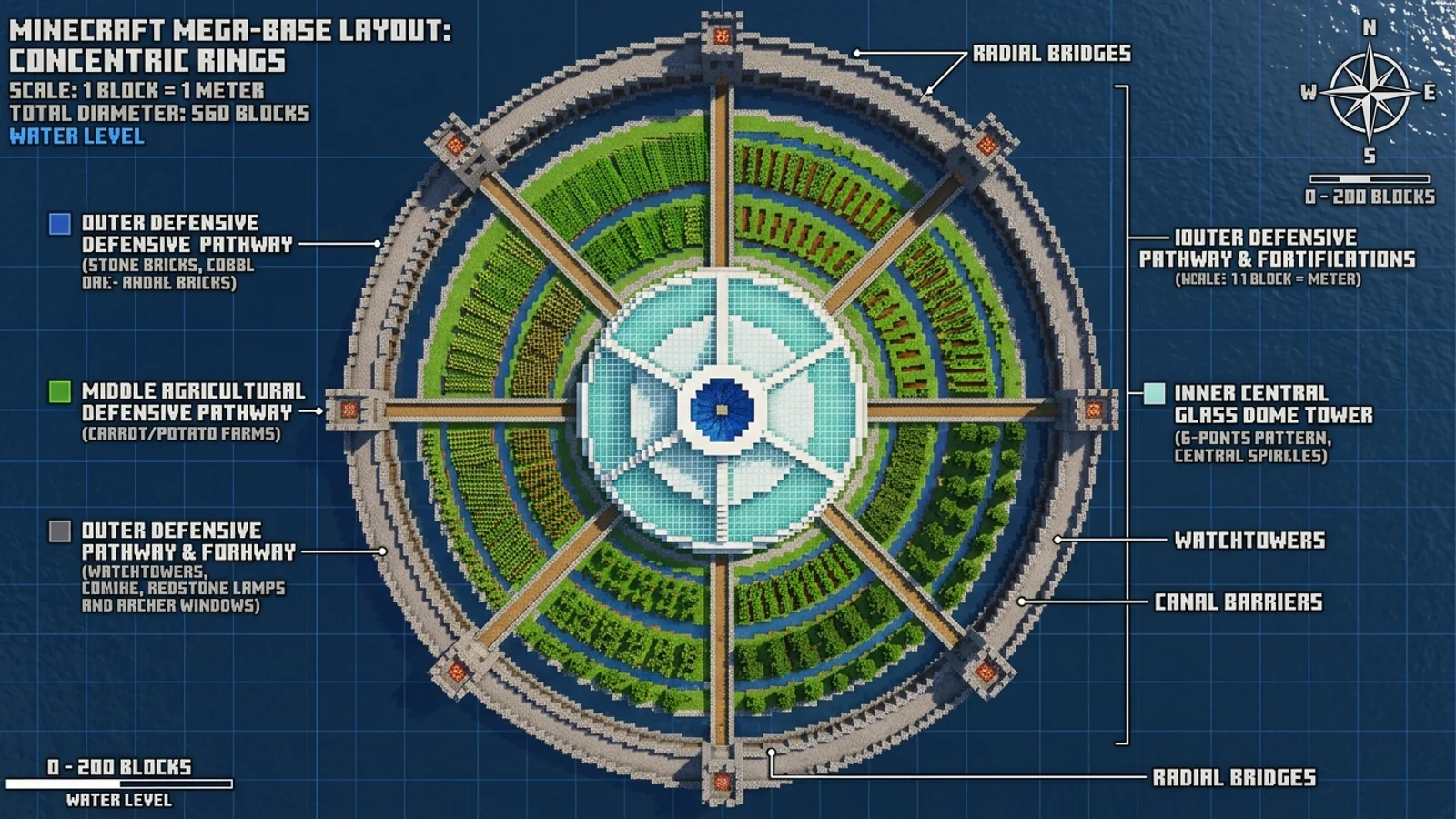
Architectural blueprint showing central core tower, radial connecting bridges, and partitioned agricultural/residential zones.
2. Radial Zoning: Dividing 360 Degrees into Pie Slices
Once your concentric rings are mapped using the MineCircles Circle Generator, subdivide the space between Ring 1 and Ring 2 into 4 (quadrants) or 6 (hexants) dedicated functional sectors:
- North Sector (Automation & Redstone): Houses your automated Crafter item auto-crafters, bulk storage silos, and super-smelter arrays.
- East Sector (Agriculture & Biosphere): Greenhouse biodomes with micro-crop farms, beehives, tree dispensers, and water gardens.
- South Sector (Trading & Living Quarters): Themed villager library, armory, map wall gallery, and personal trophy/bed chambers.
- West Sector (Transportation & Portals): Reinforced Nether warp gate, End portal tunnel, and high-speed boat launch ramps.
3. Centralizing the Automated Crafter Storage Core
Modern mega-bases in 2026 are revolutionized by the redstone Crafter. Instead of massive 100-block-long double chest walls, build a radial Crafter storage carousel:
- Radial Input Hoppers: Route item delivery water streams in a circle around your central beacon.
- Automated Crafter Compression: Set dedicated Crafter blocks beneath your iron, gold, redstone, and crop inputs to automatically compress raw ingots into storage blocks before chest delivery.
- Vertical Drop Tubes: Use bubble column elevators in the central 5x5 column to cycle bulk overflow into sub-floor storage vaults.
4. Multi-Tiered Elevation: Sunken vs. Floating Rings
Flat circular bases look repetitive. To give your mega-base epic architectural presence, introduce vertical depth:
- The Sunken Crater Design: Excavate the inner core 15–20 blocks below ground or sea level, leaving the outer ring at surface level with cascading waterfalls and stepped terrace gardens.
- The Floating Acropolis: Elevate the core tower 30 blocks above the outer ring on monumental structural arches (see our Arches & Curved Bridges Guide for load-bearing bridge techniques).
5. Step-by-Step Blueprint Execution Order
Follow this phased roadmap to ensure your mega-base is functional from Day 1 without getting overwhelmed:
- Mark Center & Cardinal Points: Place your center anchor and run 4 straight 100-block axis lines (North, South, East, West).
- Lay the Core Ring (Diameter 35): Generate the blueprint in the Circle Generator, lay the outline, and immediately establish your bed, enchanting setup, and basic sorting chests.
- Construct Radial Bridges: Build 5-block wide bridges connecting the core to where Ring 2 will sit.
- Lay the Middle Ring (Diameter 75): Build the outer walkway and infill your quadrant farms one sector at a time.
- Erect Decorative Domes & Roofs: Finish your central glass atrium or geodesic domes (refer to our Layer-by-Layer Dome Guide).
By relying on mathematical circle generation and structured concentric rings, your mega-base will become an inspiring, organized survival headquarters you'll enjoy building and expanding for years.
Related Articles
The Science of Voxel Shapes: Mastering Advanced Sphere and Circle Architectures in Minecraft
The definitive guide to voxel geometry, advanced sphere architectures, and optimal block distribution for mega-structures in Minecraft as of 2026.
December 24, 2025How to Build Arches and Curved Bridges in Minecraft
Learn to build stunning arches and curved bridges in Minecraft. Master semi-circle techniques for aqueducts, doorways, and architectural masterpieces.
September 6, 2026Minecraft Circle Size Guide (2026): Exact Diameters for Any Build
2026 Minecraft Circle Size Guide: Find the exact circle diameter for towers, domes, nether hubs, crafter automation rooms, and arenas with block count charts.