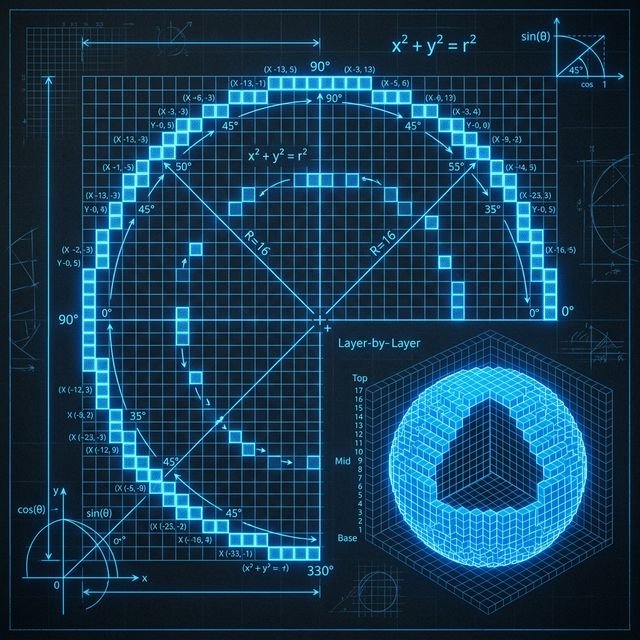
In a universe defined by right angles and 1x1x1 cubes, the circle is an anomaly. Building a curve in Minecraft isn't just an architectural choice—it's a rebellion against the grid. What we perceive as a "perfect" circle is actually a sophisticated optical illusion, a rasterized approximation of Euclidean geometry on a discrete coordinate system.
As builders, we often struggle with "jagged" edges or lopsided quadrants. By understanding the underlying algorithms that power generators like ours, you can transcend simple block-counting and master the physics of the pixelated curve.
The Algebraic Foundation: x² + y² = r²
The journey of every circle begins with the Cartesian coordinate system. In a continuous world, a circle is the set of all points (x, y) that satisfy the equation where the sum of their squares equals the radius squared. In Minecraft, however, our "points" are the centers of discrete blocks.
The challenge arises when the mathematical line passes through the middle of a block. Do we fill it, or leave it empty? This is the fundamental question of Rasterization.
📐 The Midpoint Decision
When a curve lies between two blocks, the generator must calculate which block center is closer to the ideal radius. This "error margin" is what determines whether your circle looks smooth or like a series of disjointed stairs.
Bresenham’s Legacy: The Algorithm of the 60s
While modern computers can handle complex square roots in nanoseconds, early graphics hardware could not. In 1962, Jack Elton Bresenham developed an algorithm that used only integer addition and subtraction to draw circles. This same efficiency makes it the backbone of almost every Minecraft circle generator today.
The Power of Octant Symmetry
A circle is mathematically unique because it possesses eight-way symmetry. If you know the coordinates for a single point $(x, y)$ in the first 45 degrees of the circle (one octant), you automatically know seven other points:
- $(y, x)$, $(-y, x)$, $(-x, y)$
- $(-x, -y)$, $(-y, -x)$, $(y, -x)$, and $(x, -y)$
For survival builders, this is a game-changer. You only need to count and verify 12.5% of your circle. Once that "seed" octant is perfect, you can mirror it to ensure absolute mathematical harmony across your entire build.
Advanced Geometry: Ellipses and the Ratio
While circles are the most common build, ellipses (ovals) introduce a second variable: the major and minor axes. The math shifts from a single radius to a flattened focal point system. Building an oval requires managing two different "step rates"—the frequency at which the curve shifts from horizontal to vertical segments.
The Golden Ratio in Circular Builds
Authoritative architectural research suggests that circles following the "Golden Ratio" or Fibonacci sequences in their tiered layers (like in a dome) appear more natural to the human eye. When stacking circles to create a sphere, reducing the diameter by a Fibonacci-adjacent sequence can create a more organic, "rounded" appearance than a linear reduction.
💡 Research Tip: The "Perception" Threshold
Did you know that after a diameter of roughly 64 blocks, the human eye begins to perceive the "steps" in a Minecraft circle as a smooth curve? This is due to pixel density. If your circle looks "too blocky," it's likely because the scale is too small for the resolution of the blocks.
Comparative Analysis: Manual vs. Algorithmic
| Feature | Manual Counting | Midpoint Algorithm |
|---|---|---|
| Symmetry | Prone to human error | Mathematically perfect |
| Planning Time | High (minutes/hours) | Instant (millisecond) |
| Scalability | Difficult above 30 blocks | Infinite (1-1000+) |
Building for Perspective: LOD and Viewing Distance
In environmental design, we often talk about Level of Detail (LOD). In Minecraft, your circle's "smoothness" depends entirely on where the player stands. If you are building a giant coliseum, a diameter of 200 blocks will look like a perfect circle from the air, even if the "flats" are 15 blocks long. When building at this scale, trust the math over your initial close-up intuition.
Conclusion: The Architect’s Mindset
Embracing the mathematics of Minecraft circles doesn't take away the creativity—it empowers it. By understanding that you are essentially acting as a human graphics processor, you can plan more complex, ambitious, and geometrically sound structures.
Put the Algorithms to Work
Don't waste time solving quadratics in your head. Let our generator handle the logic while you handle the legacy. Construct your perfect curve today.
Launch Generator