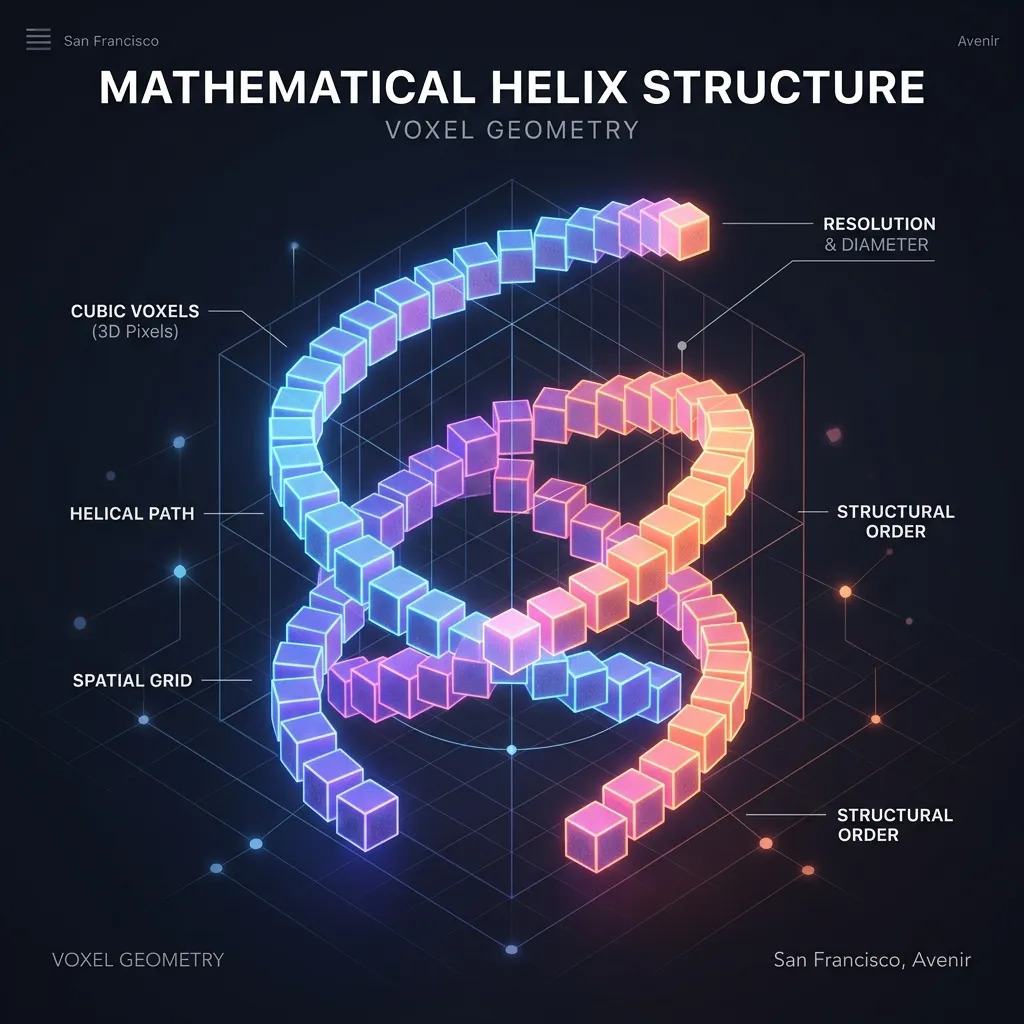
Every builder in Minecraft ultimately grapples with the transition from two-dimensional planes to complex three-dimensional curves. While mastering the horizontal circle gives you the foundation for grand towers and rounded walls, the vertical integration of curves—specifically the helix and the spiral—presents a radically different set of mathematical and structural challenges. A helix brings kinetic energy to static architecture. It is the core mathematical structure behind grand wizard tower stairwells, twisting alien monoliths, floating magical DNA strands, and the fluid architectural flourishes of high-end builds.
In standard real-world geometry, a helix is a smooth, continuous three-dimensional space curve. In the pixel-driven, right-angled environment of Minecraft, translating that infinite smoothness into clunky 1-meter cubic voxels requires a deep understanding of parametric geometry and rasterization. A poorly constructed spiral looks jagged, disconnected, and chaotic. A mathematically precise voxel spiral, however, demonstrates an incredible mastery of geometric flow.
In this authoritative, research-driven technical manual, we deconstruct the formulas of the helix, adapt classical rendering algorithms specifically designed for three-dimensional voxel architecture, and break down how you can generate these shapes with uncompromising structural integrity.
1. The Algebraic Architecture: Defining the Parametric Equation
To mathematically define a helix, we cannot rely on a simple implicit equation $f(x, y, z) = 0$ as we do for spheres and ellipsoids. A helix is fundamentally a path or a curve rather than a bounded surface volume. Therefore, we must define it using parametric equations, where each coordinate is generated as a function of an independent variable (the parameter $t$).
Given the standard coordinate system of Minecraft—where the $X$-axis and $Z$-axis define the horizontal terrestrial plane, and the $Y$-axis governs vertical height—the parametric definition of a right-handed helix is as follows:
z(t) = r · sin(t)
y(t) = a · t
Deconstructing the Mathematical Variables
Unlike a two-dimensional circle, the helix demands a temporal-like parameter $t$ to draw itself continuously outward into space. Here is the breakdown:
- The Parameter ($t$): This variable represents the angle of rotation in radians. As $t$ increases from $0$ to $2\pi$, it completes precisely one full revolution around the central axis. We allow $t$ to scale to infinity to continuously stack the helix upward.
- The Radius ($r$): This is the distance from the central axis to the curve, measured in blocks. In a standard continuous helix, $r$ is constant. If $r$ shrinks as $t$ increases, the resulting shape is a conical spiral—a shape we will discuss in advanced applications later.
- The Pitch/Height Coefficient ($a$): This is perhaps the most critical architectural variable. It defines the vertical climbing speed of the helix. Specifically, the vertical distance separating one full turn from the next—the pitch of the helix—is exactly $2\pi \cdot a$. By tuning $a$, a builder determines if the staircase feels steeply treacherous or elegantly sloped.
In a continuous universe, these equations produce a perfectly smooth strand. In Minecraft, however, our destination is a matrix of discrete coordinates. The parameter $t$ must be evaluated, the results plotted, and then firmly rounded into $integer$ grid locations.
2. The Voxelization Problem: Rasterization in 3D
The translation of continuous math into discrete blocks introduces a notorious computational barrier known as the sampling gap problem. If you construct a simple loop in Java or Python and simply increment $t$ by a flat value, say $0.5$ radians, the $x$, $y$, and $z$ coordinates will jump drastically between steps.
Consider a massive tower where the radius $r = 50$ blocks. An angular step of $\Delta t = 0.5$ radians corresponds to a horizontal arc length travel of $s = r \cdot \Delta t = 25$ blocks. The resulting voxel translation will place one block, then skip 24 empty spaces, before placing the next block. It is no longer a continuous staircase; it is a scattering of disconnected floating points in space. Conversely, if $r$ is very small, a miniscule $\Delta t$ will redraw the same voxel multiple times, wasting immense processing power.
The Dynamic Arc-Length Synchronization
To overcome this issue without brute-forcing the processor, elite voxel architects do not step through the angular parameter $t$ uniformly. Instead, they dynamically scale the step size $\Delta t$ to constrain the spatial distance between iterations to exactly one block limit (a distance of roughly $1.0$ or smaller in 3D Euclidean space).
Calculation Focus: Synchronizing Delta t
The arc length distance covered along the helical path for a tiny change $dt$ is given by the derivative vector magnitude: $ds = \sqrt{r^2 + a^2} \cdot dt$.
To ensure we never skip a block, we must restrain the arc length step to be less than $0.5$ units (half a block). Therefore, the optimal iterative step size becomes:
$\Delta t = \frac{0.5}{\sqrt{r^2 + a^2}}$
By enforcing this geometric limit in your scripts or planning algorithms, you guarantee an unbroken, beautiful curve regardless of the gigantic scale of the radius or pitch.
3. Advanced Rasterization: Beyond Parametric Sampling
While parametric sampling with dynamic $\Delta t$ works for simple shapes, highly complex algorithmic builds rely on a three-dimensional adaptation of the Bresenham's Line Algorithm. A pure mathematical function rounded to nearest integers leads to erratic corner connections (voxels touching only at their mathematical edges diagonally without orthogonal face-contacts).
In a properly voxelized architectural environment, a helix should ideally be horizontally connected (no air gaps) to maintain a cohesive surface structure. This requires defining a volumetric boundary condition—often known as an "implicit thickness" model, turning the infinitesimal mathematical curve into a tube with a radius defined as $R_{tube} \ge 0.5$. The algorithm evaluates voxels based on their proximity to the theoretical spine equation mapping. Only voxels where the shortest orthogonal distance to the parametric spine is $\le 0.5$ are rendered solid.
The result is a staircase with organic depth, resisting the awkward 'thinness' that plunders low-tier algorithmic building and producing a shape that feels visually fortified and structurally sound to the human eye.
4. Scaling Proportions and Architectural Thresholds
Much like circles, helixes have critical block thresholds where their geometry looks beautiful vs severely disjointed. The voxel grid hates diagonal slopes that don't conform to integer ratios (e.g. 1 block over, 1 block up). Let's review the architectural sizing conventions established over vast iterations of high-level community building.
| Helical Typology | Radius (r) | Pitch (a) | Visual Characteristics | Typical Application |
|---|---|---|---|---|
| Micro Spiral | 3 - 5 blocks | 0.5 - 1.0 | Highly aggressive, steep. Often requires slabs to connect vertically. Visually chaotic without a central central support pillar. | Watchtower Stairwells, Lighthouse cores. |
| Grand Ascent | 12 - 20 blocks | 2.5 - 4.5 | Elegant sweeping curves. Offers enough horizontal run for 2-3 block wide platforms per angular sweep. Natural feeling slopes. | Mage Tower exterior ramps, Grand Library staircases. |
| The Double Helix | 25 - 40 blocks | 8.0+ | Massive void space between revolutions. Striking visual depth. Requires two interwoven parametric curves phase-shifted by $\pi$. | Sci-Fi structural struts, Organic DNA structures, Magical anomalies. |
| Conical Helix | Variable (r decreases with y) | 3.0+ | Tapers gracefully to a point. Very complex to smooth as the block stepping ratio changes dynamically with height. | Spire ornaments, Elven architecture peaks. |
Architectural Insight: The human eye prefers predictable climbing ratios. When the parameter $a$ creates a slope of exactly 2 blocks horizontal spread for every 1 block of vertical climb, you can exclusively utilize standard Minecraft Slab and Stair properties to generate flawlessly smooth inclines. When mathematics aligns with the engine's inherent sub-block geometry, masterpieces are constructed.
5. Orchestrating The Double Helix
For builders seeking the apex of technical architecture, constructing a Double Helix—two continuous, independent curves winding seamlessly around the same axis—is a rite of passage. This structure is universally recognized from the molecular modeling of DNA and forms a striking visual motif for technological and magical settings.
The mathematics require generating a primary helix, and then simultaneously generating a secondary curve that mirrors the first but begins at a different starting position. This shift is controlled by adding a phase angle difference ($\phi$) to the parameter $x$ and $z$ components.
- Strand Alpha:
$x_{\alpha} = r \cos(t)$
$z_{\alpha} = r \sin(t)$
$y_{\alpha} = a \cdot t$ - Strand Beta:
$x_{\beta} = r \cos(t + \pi)$
$z_{\beta} = r \sin(t + \pi)$
$y_{\beta} = a \cdot t$
By shifting Strand Beta by precisely $\pi$ radians ($180^\circ$ degrees), the two strands are permanently fixed at opposite sides of the imaginary cylinder they encompass. They will wind endlessly upward but remain mathematically prevented from ever colliding. Connecting these strands periodically with structural "rungs" (horizontal beams extending through the central axis) completes the DNA lattice aesthetic.
6. Tooling Applications: Executing the Math via WorldEdit
Manually calculating these coordinates is computationally fascinating but practically devastating for build timelines. Top-tier architects leverage the `//generate` (`//g`) syntax of WorldEdit to execute these geometric expressions directly onto the server processor. While WorldEdit's syntax varies slightly and often relies heavily on bounded shapes, specific scripts can leverage the engine gracefully.
An example WorldEdit expression to generate a localized structural helix within a selected cylindrical region uses the evaluation of position coordinates $(x,y,z)$. The expression translates to true (placing a block) if the voxel lies on the path:
//g stone (sqrt(x^2+z^2)-R)^2 + (y/A - atan2(z,x))^2 < ThicknessThis formulation tests every block in the selection area, utilizing the arctangent functionality to derive rotational angle $t$ and verifying if vertical position $y$ corresponds dynamically to that angle. By adjusting $R$ (radius), $A$ (climb variance), and Thickness parameters, the entire generation handles its own coordinate rounding intrinsically.
7. Texturing and Detailing The Curves
A bare mathematical curve placed into a Minecraft world lacks grounding and atmospheric texture. Because of the inherent diagonal slanting in voxel helixes, lighting engines will cast incredibly chaotic, noisy shadows against non-uniform block faces.
- Mitigating Shadow Noise: Introduce continuous lighting strips tracking the inside curve of the spiral using Sea Lanterns or Froglights set beneath stained glass. A continuous emission curve overrides scattered global shadows.
- The Half-Block Solution: Do not use full solid blocks for helical slopes. The voxel "stepping" aliasing is harsh. By replacing consecutive vertical steps with Bottom Slabs, Top Slabs, and then Full Blocks, the perceived resolution of your curve doubles without altering the mathematical foundation.
- Organic Distortion: Once an algorithmic helix is deployed, breaking it slightly adds to the narrative. Allow hanging vines, collapsed sections, or overgrowth to intersect the perfect geometry. The contrast between algorithmic purity and chaotic natural decay creates a brilliant focal juxtaposition in environmental design.
8. Conclusion: Architecture that Ascends
The mathematical leap from plotting static, flat 2D blueprints to designing dynamic, ascending 3D space curves fundamentally changes how a Minecraft architect perceives volumetric space. The voxel helix is an affirmation that rigid blocks can mimic organic flexibility provided the mathematical grounding is pristine. By applying these parametric structures thoughtfully—understanding scaling, phase angles, and step rasterization—your constructions will transcend the terrestrial aesthetic and wind flawlessly into the sky.
This is where rigid block constraints meet unfettered geometric expression. The mathematics scale infinitely; the only absolute limit is how bold your vision dares to climb.
Build Beyond Limits
Equip yourself with the technical blueprints required for monumental structures using our resources, and let complex geometry handle the heavy lifting for your most elaborate artistic projects yet.
Open Geometry GuideComprehensive FAQ
Is it better to build spirals manually or generate them?
For a radius smaller than 5 blocks, manual building is often faster simply due to intuitive placement and adapting the shape dynamically via visual feel. For any radius greater than 10 blocks, manual placement invites massive symmetry errors. Generation using rigorous mathematical scripts ensures immaculate parity across the entire structure.
How do I make a spiral staircase that feels completely flat when walking up?
To ascend smoothly without jumping, the slope defined by the pitch $a$ must allow exactly one block of height change over at least one block of horizontal space per arc-interval. Use Minecraft Stair blocks facing tangentially along the curve. Ensure that $2\pi \cdot a$ yields a total height roughly equal to the total block perimeter ($2\pi \cdot r$). This grants a steady 1:1 slope.
My WorldEdit spiral has huge gashes/holes in it. Why?
You have encountered the rasterization sampling problem detailed in Section 2. The angular step evaluating your algorithm is too large, or your implicit "thickness" variable is too thin for the block boundary. Ensure that the distance evaluated between any two steps of $t$ is significantly less than the diagonal width of a block (roughly 1.414 units), or increase the bounding voxel radius slightly above $0.5$.
Can I generate a helix that speeds up or slows down its climb?
Yes. This is achieved by altering the vertical function from a linear scalar $y(t) = a \cdot t$ to an exponential or logarithmic function, such as $y(t) = a \cdot t^2$. The result is a helix that begins tightly coiled at its base and then radically stretches out the further upward it climbs, appearing like a loaded spring under tension.