Round towers are the crown jewels of medieval castle architecture. Unlike square towers, cylindrical towers are stronger against siege weapons (fewer corners to exploit), look more imposing, and add authentic historical flair to any castle build. The secret to building them perfectly? Understanding circle patterns.
In this comprehensive guide, you'll learn how to use our circle generator to build everything from modest watchtowers to massive keep towers, complete with battlements, arrow slits, and interior spiral staircases.
Why Build Round Towers?
Medieval architects knew something modern Minecraft builders are still learning:
- Structural strength: Round towers have no corners to undermine during sieges
- Better visibility: Defenders can see in all directions without blind spots
- Aesthetic appeal: Cylindrical shapes look grander and more sophisticated
- Historical accuracy: Most real medieval castles featured round towers
📦 Recommended Materials
Tower Types by Size
Watchtowers are the smallest round towers, typically placed at castle corners or along walls. They provide elevated positions for archers and sentries without taking up much space.
At this size, the interior is very tight—usually just enough for a ladder or tight spiral stair. Perfect for decorative towers that don't need functional interiors.
📐 Specifications
- Diameter: 5-7 blocks
- Height: 15-25 blocks
- Interior space: Very limited (3-5 blocks)
- Best for: Corner towers, decorative spires
Flanking towers project from castle walls to provide crossfire against attackers. They need enough interior space for defenders to move and access arrow slits on multiple levels.
This is the most common tower size for functional castle builds—large enough to be useful, small enough to build multiples along your walls.
📐 Specifications
- Diameter: 9-13 blocks
- Height: 20-35 blocks
- Interior space: Comfortable (7-11 blocks)
- Best for: Gatehouse towers, wall towers
The keep is the heart of the castle—the last line of defense and the lord's residence. Keep towers are impressively large, with multiple floors containing living quarters, storage, and defensive positions.
Building a circular keep is a major project, but the result is a stunning centerpiece that dominates the castle skyline.
📐 Specifications
- Diameter: 17-25 blocks
- Height: 35-50+ blocks
- Interior space: Spacious (15-23 blocks)
- Best for: Castle centerpieces, standalone towers
Step-by-Step Building Guide
Generate Your Circle Pattern
Open the circle generator and set your desired diameter. For a standard flanking tower, try 11 blocks. Make sure to select Filled: Off to get just the wall outline.
Screenshot or memorize the pattern—you'll follow this exact shape for every layer of your tower walls.
Lay the Foundation
Build the foundation 2-3 blocks thick using cobblestone or mossy cobblestone for a weathered look. The foundation should be filled solid and extend slightly into the ground.
If building on uneven terrain, continue the foundation down until it meets solid ground on all sides.
Build the Walls
Follow your circle pattern layer by layer, using stone bricks for the main walls. Build up to your desired height, leaving gaps for:
- Arrow slits: 1 block wide, 2-3 blocks tall, every 5-7 blocks apart
- Windows: Larger openings on upper floors (2-3 blocks wide)
- Door: Ground level entrance, 2 blocks tall minimum
Add Battlements
The top of your tower needs crenellations—the classic castle tooth pattern. Follow your circle pattern at the top, then:
- Place stone walls or full blocks as merlons (the raised parts)
- Leave gaps as crenels (the lower parts defenders shoot through)
- Alternate: 2 blocks merlon, 1 block crenel works well
Add slabs on top of merlons for a finished look.
Install Spiral Stairs
Medieval towers almost always had spiral staircases built into the walls. Check our spiral staircase guide for the complete technique.
For towers under 9 blocks diameter, you may need to use ladders or a central column stair instead—there isn't enough wall thickness for proper spirals.
💡 Pro Tip: Wall Thickness
Real medieval tower walls were 2-3 blocks thick. If your tower is large enough (13+ diameter), consider building double-thick walls. This allows you to embed spiral stairs within the wall itself, just like historical castles.
Decorative Details
Arrow Slits
Arrow slits (or arrow loops) are narrow vertical openings that let defenders shoot out while providing minimal target for attackers. Build them 1 block wide and 2-3 blocks tall, spaced evenly around the tower.
Machicolations
These are floor openings at the top of the tower that let defenders drop things on attackers below. Create them by extending the battlements outward with stairs or slabs, leaving gaps in the floor.
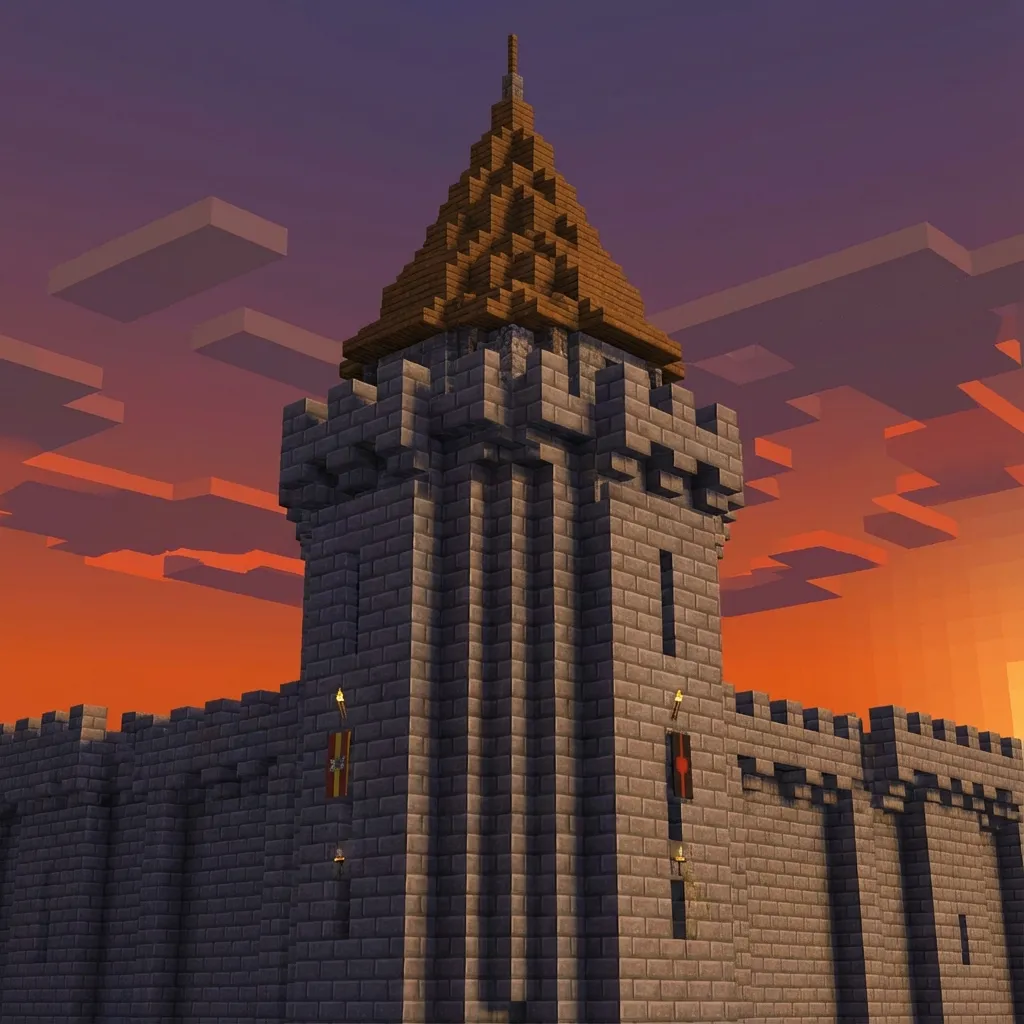
Conical Roof (Optional)
Many medieval towers had pointed roofs. Use our circle generator with progressively smaller diameters stacked on top of each other, using stairs to smooth the curve.
🏰 Historical Note
French and German castles often had conical "witch hat" roofs on their towers, while English castles typically had flat roofs with battlements. Choose based on the architectural style you want!
Connecting Towers to Walls
Towers are most effective when integrated into castle walls:
- Corner towers: Place at wall intersections, overlapping both walls
- Gatehouse towers: Flank the main gate entrance as a pair
- Wall towers: Space every 30-50 blocks along long walls
The wall should seamlessly merge into the tower's circumference. Generate your tower circle first, then build walls tangent to it.
Start Your Castle Project
Generate circle patterns for towers, walls, and more.
Open Circle Generator