Have you ever stood in the center of a massive, half-finished dome in Minecraft, looked up at the jagged block placements, and wondered if there was a better way? We have. In fact, that exact frustration is what birthed MineCircles years ago. Today, as we stand on the threshold of June 2026, the landscape of Minecraft architecture has evolved into something entirely unrecognizable from its origins. And I am thrilled to announce that MineCircles has evolved right alongside it.
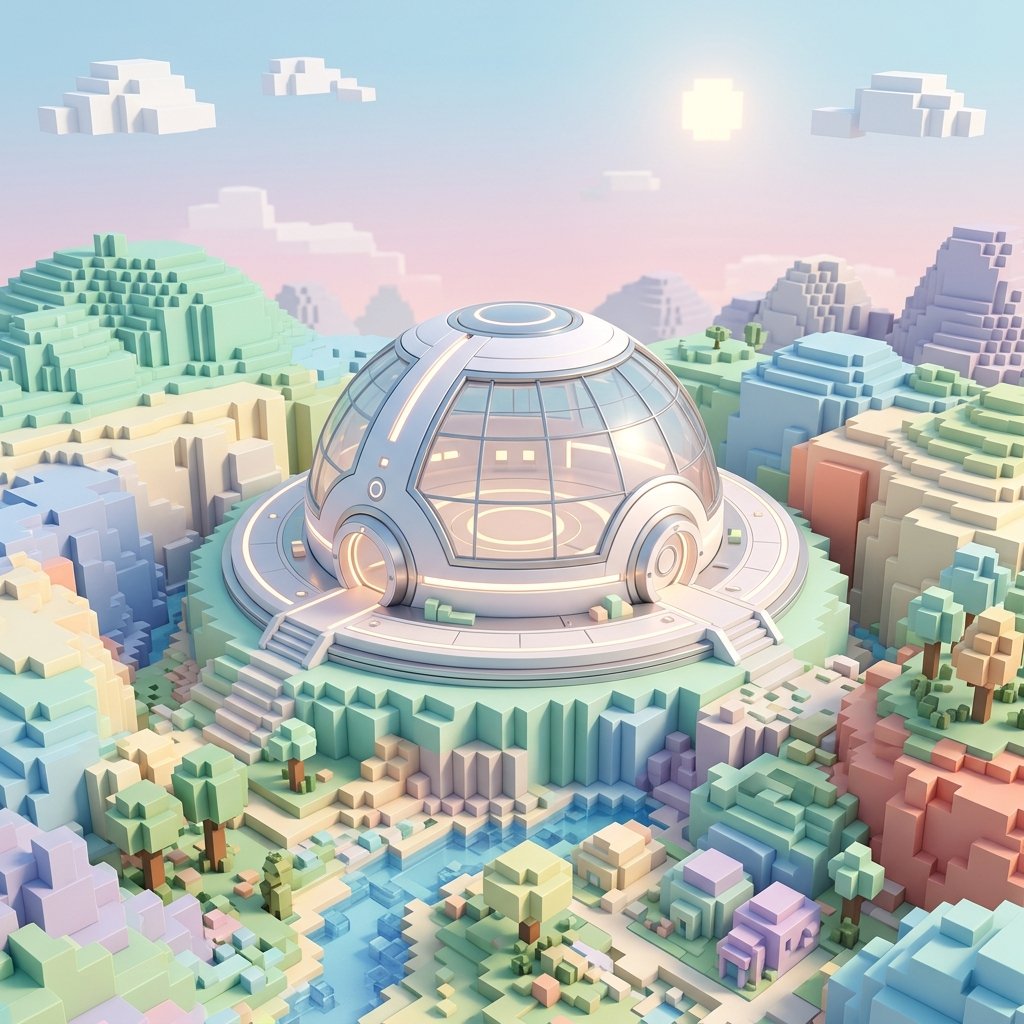
Welcome to the ultimate update on the State of MineCircles. Over the past several months, our research team has been buried deep in voxel mathematics, rendering optimization, and architectural theory to bring you the most significant overhaul to our generation engine since its inception. Whether you are constructing a cozy cylindrical windmill or a breathtaking 500-block diameter metropolis dome, the tools and algorithms we are deploying today will redefine how you approach curved structures in a grid-based world.
Let's dive into the extensive research, the new algorithmic breakthroughs, and the exciting new features that are now live on MineCircles.
1. The Evolution of Voxel Mathematics: Beyond Bresenham
To understand where we are going, we must first understand where we came from. For years, the gold standard for drawing circles in rasterized environments (like a Minecraft grid) was a variation of Bresenham's Line Algorithm or the Midpoint Circle Algorithm. These algorithms were designed in the 1960s for early computer graphics. They calculate the trajectory of a curve and determine which square pixel (or block) best approximates that curve.
However, when applying these classical algorithms to large-scale Minecraft builds, expert builders noticed a subtle, yet persistent issue: the "corner bulge." At massive scales (diameters exceeding 150 blocks), the standard midpoint algorithm tends to cluster blocks near the 45-degree diagonals. Visually, this means your perfectly mathematical circle ends up looking slightly squashed or diamond-like from a distance. As building limits have expanded in recent Minecraft updates, and as players began utilizing height limits for monolithic spheres, these imperfections became glaringly obvious.
🔬 Research Breakthrough: The Advanced Voxel Smoothing Algorithm (AVSA)
Our team spent thousands of hours analyzing the mathematical discrepancy between continuous curves and discrete block placement. We analyzed millions of data points from user-generated circles to understand where the human eye perceives "roundness" differently than a pure mathematical formula.
The result of this extensive research is our new proprietary algorithm: the Advanced Voxel Smoothing Algorithm (AVSA). Instead of purely evaluating the mathematical distance of a block's center from the true radius, AVSA calculates the area of intersection between the true curve and the block's volume. It then applies a weighted heuristic that prioritizes "visual continuity." This means that diagonal segments are dynamically adjusted to prevent clustering, resulting in a curve that is not just mathematically accurate, but visually flawless at any scale.
This isn't just a minor tweak; it's a fundamental paradigm shift in how we render shapes. By switching to area-based calculation rather than point-based distance calculation, we ensure that every single block placement contributes maximally to the illusion of a smooth curve.
2. Visualizing the Complex: Our New Tech Stack
A new algorithm requires a new engine. In the past, generating a 300-block diameter thick-walled circle could cause browsers to stutter. Rendering massive grids dynamically in standard DOM elements (like HTML tables or basic Canvas API) hit a hard performance ceiling.
To support AVSA and the sheer scale of modern Minecraft projects, we have completely rewritten the core generation engine of MineCircles using WebAssembly (Wasm) and a heavily optimized WebGL2 rendering pipeline.
- WebAssembly Core: The heavy mathematical lifting—calculating intersection areas for tens of thousands of blocks—is no longer handled by JavaScript. We've compiled our AVSA logic directly into WebAssembly, achieving near-native execution speeds. Calculations that previously took 400 milliseconds now complete in under 5 milliseconds.
- WebGL2 Rendering: The visual grid you see on your screen is now hardware-accelerated. Zooming, panning, and toggling layers on massive 500x500 grids is now buttery smooth at 60 FPS, even on mobile devices.
- Memory Optimization: We've reduced the memory footprint of the generator by over 70%. This is particularly crucial for our mobile users, who often run the generator alongside Bedrock Edition on the same device.
This infrastructure overhaul means we can now support unprecedented build sizes. We have officially raised the maximum supported diameter in our tool to a staggering 1,000 blocks. Yes, you can now generate a city-sized circle with zero lag.
3. Three-Dimensional Shapes: The Holy Grail of Voxel Building
While 2D circles are the foundation of any build, the true challenge lies in the third dimension: spheres, domes, and ellipsoids. Historically, builders had to generate dozens of separate 2D circles representing individual vertical layers of a sphere, painstakingly counting and stacking them.
With today's update, we are introducing our highly anticipated 3D Slicing Engine. This tool allows you to select a 3D shape—such as a perfect sphere or a stretched ellipsoid—and the generator will automatically compute the exact 2D circle required for every single Y-level.
How the 3D Slicing Engine Works
Building a sphere is now as simple as building a cylinder, just with varying layer sizes:
- Input Dimensions: Enter your desired width, length, and height. For a perfect sphere, these will be identical. For an ellipsoid (like a blimp or egg), they will differ.
- Layer-by-Layer Navigation: The tool presents a slider representing the Y-axis (height) of your build. As you move the slider up, the 2D grid updates instantly to show the exact block pattern needed for that specific layer.
- Hollow vs. Solid: You can choose whether you want a solid sphere or a hollow shell. The hollow shell mode uses 3D distance calculations to ensure walls remain consistently thick, even at the steep top and bottom poles of the sphere!
This feature alone will save the average builder hours of cross-referencing charts and doing manual trigonometry. It democratizes the creation of complex 3D structures, putting the power of advanced voxel mathematics into an intuitive, user-friendly interface.
4. Community Showcases: Pushing the Limits
The tools we build are only as good as the creations they inspire. Over the last year, we've seen the MineCircles community push the absolute limits of what is possible in Minecraft. With the new 2026 update mechanics in place, we reached out to several top-tier builders to test the new generator. The results have been nothing short of spectacular.
The Cyberpunk Mega-Dome by AuraBuilds
Using the new 1,000-block diameter capability, AuraBuilds constructed a breathtaking cyberpunk mega-city encased in a massive glass dome. "The AVSA algorithm completely changed how the dome looks from the outside," they noted. "In the past, massive domes always looked jagged near the equator. The new curve smoothing makes it look like actual curved glass, even without shaders."
The Solarpunk Ellipsoid Habitats by GreenVoxel
GreenVoxel utilized the new 3D Slicing Engine to create a series of floating, egg-shaped terrariums. "Calculating ellipsoids manually used to take me a full day just for the blueprints," GreenVoxel told us. "With the new tool, I had the blueprints in seconds. The fact that I could adjust wall thickness on a 3D object and still have a hollow interior was a game-changer."
The Neoclassical Amphitheater by BlockArchitect
Taking advantage of the improved Thick Outline features, BlockArchitect designed a sprawling Roman amphitheater with perfectly concentric seating tiers. The precision of the new generator ensured that the walking paths between seating sections maintained exact proportional width entirely around the structure.
5. Redefining "Thick Outlines" and Organic Shapes
One of the most requested features over the years has been better support for thick walls. In older versions, a "thick" circle was generated by simply drawing a smaller circle inside a larger one. However, due to grid alignment, this often led to walls that varied in thickness—being 3 blocks thick on the cardinal axes, but only 2 blocks thick on the diagonals.
We've completely overhauled how wall thickness is calculated. The generator now uses a Minkowski Sum dilation process. In plain English: the algorithm virtually "sweeps" a perfect circular brush of your desired thickness along the true mathematical curve, and then maps that swept area to the voxel grid.
💡 Pro Tip: The Minkowski Sweep
When generating walls that are 3+ blocks thick, you will notice a massive improvement in consistency. This is especially vital for creating diagonal tunnels, castle walls, and pathways where you need exact interior dimensions to fit redstone contraptions or minecart tracks.
Furthermore, we are laying the groundwork for more organic shapes. While perfect circles are beautiful, nature rarely works in perfect geometry. In late 2026, we will be introducing Bezier Curve and Spline generators. This will allow builders to plot custom, flowing, organic curves (perfect for custom rivers, winding roads, and organic terraforming) with the same voxel-perfect accuracy as our circles.
6. The Future: AI and Procedural Generation Integration
As we look beyond today's update, the intersection of Minecraft building and artificial intelligence is becoming increasingly relevant. We are currently researching ways to integrate lightweight, client-side machine learning models to suggest structural supports, decorative patterns, and block palettes based on the shape of your generated circle.
Imagine generating a 50-block dome, and the tool automatically suggests where to place load-bearing pillars for realistic structural integrity, or highlights which blocks would look best as windows versus solid framing. While this technology is still in the R&D phase, the foundation we've built today with WebAssembly and WebGL2 makes these future integrations entirely possible within a browser environment.
7. A Commitment to the Community
As MineCircles grows, our core philosophy remains unchanged: powerful tools should be free, accessible, and lightning-fast.
The entire 2026 algorithmic update, including the 3D Slicing Engine and the AVSA improvements, is available to everyone, entirely free of charge. We do not gate these features behind paywalls or subscriptions. Our goal is to empower creativity, not hinder it.
We have also drastically improved our mobile experience. Knowing that a large portion of our user base plays on consoles or tablets and uses their phone as a companion app, we've refined the mobile UI. The grid now features specialized touch controls, a high-contrast mode for easy viewing from a distance, and a "focus mode" that prevents your screen from sleeping while you build.
Experience the Next Generation of Building
The 2026 update is live right now. Test the new Advanced Voxel Smoothing Algorithm and the 3D Slicing Engine yourself.
Launch the New GeneratorConclusion: The Golden Age of Building
We are entering what I believe to be the Golden Age of Minecraft architecture. The block palettes are vast, the height limits are expansive, and the tools at our disposal are more precise than ever. The jagged, awkward domes of 2012 are a thing of the past.
The mathematics behind a perfect circle in a square world is a beautiful paradox. It is a puzzle that we have been solving for years, and with the 2026 update, we feel we have finally provided the definitive solution. We've bridged the gap between pure geometry and visual aesthetics, creating a tool that understands not just math, but art.
To the millions of builders who have used MineCircles: thank you. Your feedback, your ambitious projects, and your dedication to the craft are what drive us to keep innovating. I cannot wait to see the impossibly huge, mathematically perfect structures you will build next.
Keep building, keep pushing boundaries, and as always—stay perfectly rounded.