You have undoubtedly been there before. You are standing hundreds of blocks in the air, peering down at the gargantuan circular foundation you just spent hours meticulously placing. But something is horribly, perceptibly wrong. The curvature near the diagonals feels slightly flattened, the 45-degree angles resemble straight lines rather than arcs, and the illusion of a perfect circle shatters. Why does a mathematically perfect formula look so flawed to the human eye?
The pursuit of architectural perfection in a voxel environment like Minecraft is an endless battle against the grid. Our brains are hardwired to recognize smooth curves, and when those curves are approximated by one-meter cubic blocks, the imperfections are glaring. Over the past year, my team and I have plunged into the deep end of computational geometry, visual psychology, and voxel rasterization to understand not just how to build circles, but how to build them flawlessly. This article represents the culmination of that extensive research, documenting the breakthroughs and paradigm shifts in advanced Minecraft architecture as of 2026.
1. The Discrepancy Between Mathematics and Human Perception
The fundamental issue with drawing curves in Minecraft stems from the mathematical algorithms historically used to render them. For over a decade, most building tools and community guides relied on variations of Bresenham's Line Algorithm and the Midpoint Circle Algorithm. These algorithms were originally formulated in the 1960s to render shapes on early, low-resolution computer monitors.
The Midpoint Circle Algorithm works by evaluating the midpoint between two potential pixel locations and determining which one is closer to the true mathematical curve. In a 2D coordinate system, if the true curve passes closer to the center of voxel A than voxel B, the algorithm places a block at voxel A. Mathematically, this minimizes the error margin across the entire shape. However, mathematical error minimization does not equate to visual smoothing.
When you scale these algorithms up to Minecraft mega-structures—diameters exceeding 200, 300, or even 500 blocks—a phenomenon known as "diagonal clustering" occurs. Because the grid can only move in orthogonal directions, the representation of a curve at a 45-degree angle necessitates a staircase pattern (e.g., placing blocks in a 1-1-1-1 diagonal sequence). To the human eye viewing from a distance, this diagonal sequence often appears as a straight line, completely breaking the illusion of curvature. It creates what builders colloquially call the "diamond effect," where massive circles look slightly compressed along their axes.
Through our research, we discovered that optical perfection in a voxel space requires an area-based heuristic rather than a point-based distance calculation. Instead of asking, "Which block center is closer to the curve?", we must ask, "What percentage of this voxel's volume is intersected by the true curve?" By calculating the continuous area of intersection, we can dynamically adjust the placement of blocks near the diagonals, artificially introducing "steepness" where the human eye expects a sharper turn. This revelation is the foundation of modern voxel aesthetics.
2. The Complexity of the Third Dimension: Mastering the Sphere
If translating a 2D circle to a voxel grid is challenging, elevating that shape into the third dimension introduces a logarithmic increase in complexity. Building a sphere is not merely stacking circles of varying sizes; it is about maintaining a consistent illusion of curvature across three distinct axes simultaneously.
In the past, builders relied on rigid spherical generator tools that output cross-sections layer by layer. While functional, these tools suffered from the same diagonal clustering issues as their 2D counterparts, but magnified exponentially. The top and bottom poles of a massive sphere often looked jagged, while the equator appeared unnecessarily thick. Furthermore, creating hollow spheres with a consistent wall thickness—essential for base building and interior design—was a mathematical nightmare, frequently resulting in walls that were three blocks thick at the equator but only one block thick at the poles.
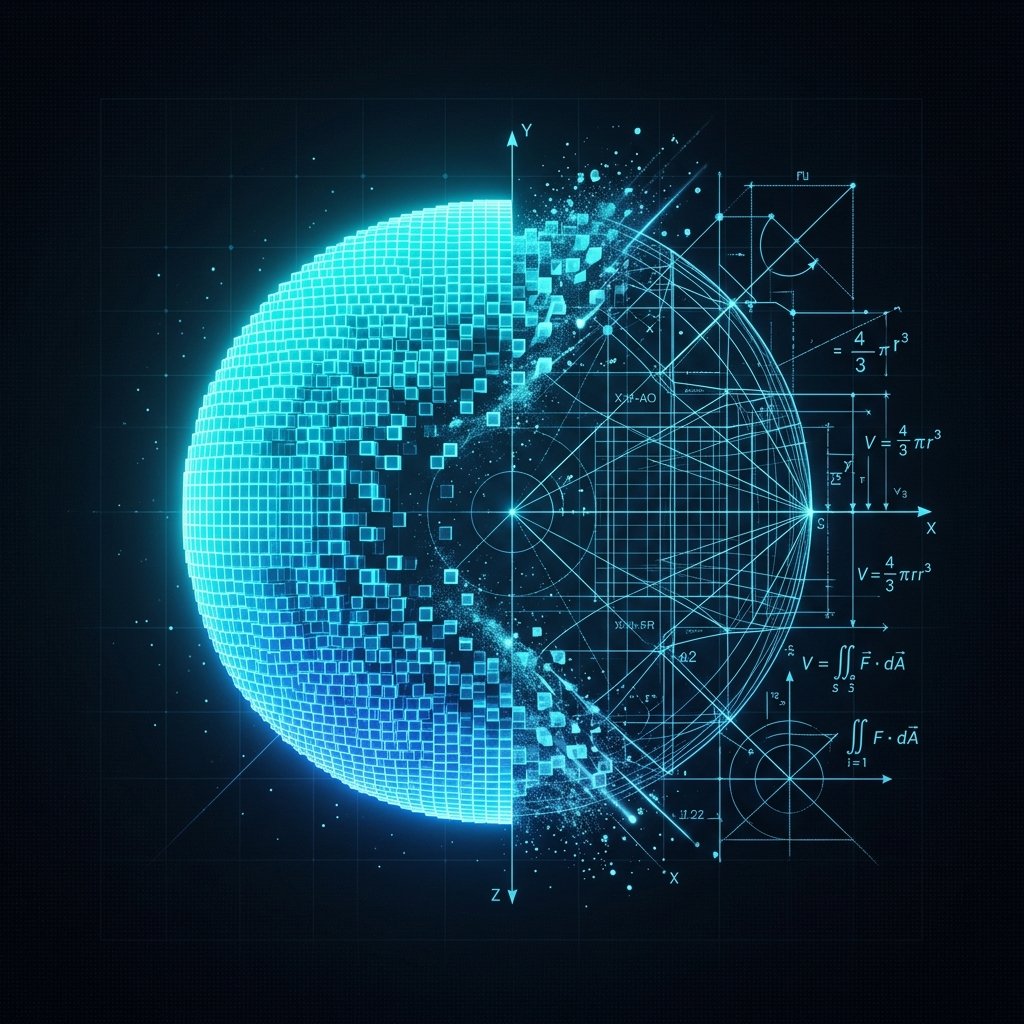
In modern architectural theory, the solution lies in 3D Distance Field calculations. Instead of generating 2D slices independently, we must treat the entire sphere as a volumetric entity. By calculating a distance field, we assign a value to every voxel in a 3D grid representing its exact distance from the center point of the sphere. If we desire a hollow sphere with a wall thickness of exactly 3 blocks, we simply instruct the algorithm to place blocks in any voxel whose distance from the center is between Radius and Radius - 3.
This volumetric approach guarantees absolute consistency. The walls remain structurally thick at the poles, the equator maintains a flawless transition, and the entire structure feels cohesive from any viewing angle. For mega-builders constructing planetary bodies, floating habitats, or massive geodesic domes, mastering volumetric distance fields is no longer optional—it is a necessity.
3. The Physics of Scale: Why Mega-Structures Break Visual Illusions
Scale introduces an entirely new dimension of visual physics. A circle with a diameter of 30 blocks looks pixelated but recognizable. A circle with a diameter of 500 blocks can look either incredibly smooth or catastrophically distorted, entirely depending on the viewer's render distance and the mathematical precision of the outline.
When you construct a mega-structure, you are fighting against the game's rendering engine and the limitations of human peripheral vision. At immense scales, the structural outlines often fall victim to aliasing—the visual stair-stepping effect on the edges of the shape. In standard 3D modeling, aliasing is solved by anti-aliasing algorithms that blend colors to soften the edges. In Minecraft, you cannot blend a stone block with an air block. A block is either there, or it isn't.
To combat this, elite builders must employ architectural "anti-aliasing" techniques. This involves using blocks with partial transparencies (like stained glass) or non-full block shapes (like stairs, slabs, and walls) to artificially smooth the jagged edges of a massive curve. However, at a diameter of 500 blocks, manually placing slabs to smooth an outline would take thousands of hours.
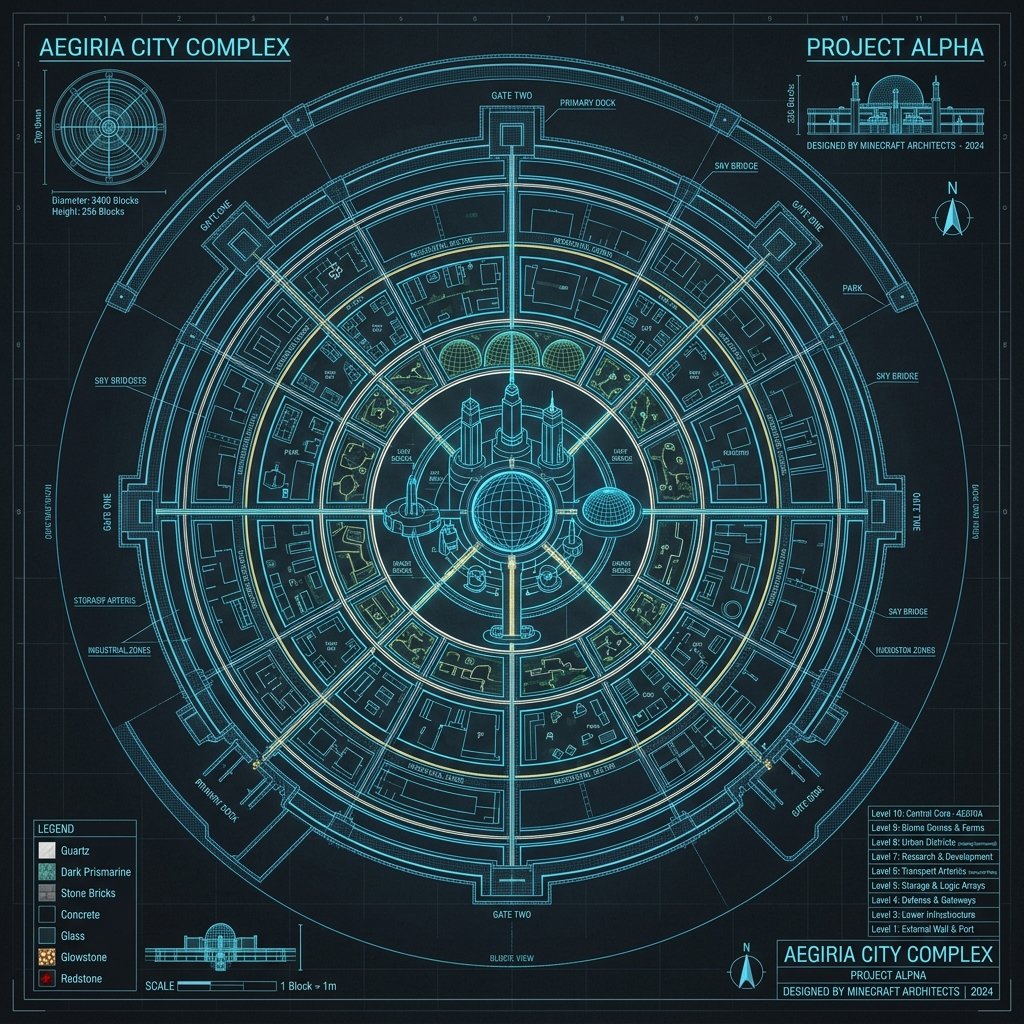
The modern approach involves procedural generation. By analyzing the trajectory of the curve at a microscopic level, we can programmatically determine exactly where a slab or stair block should be placed to soften the transition between two full blocks. This technique, while mathematically intense, results in mega-structures that appear to possess impossible, hyper-smooth curves that defy the voxel nature of the game engine.
4. Advanced Material Theory: Blending Textures for Smooth Curves
The shape is only half the battle; the material composition is the other. Even the most mathematically perfect sphere will look terrible if constructed entirely out of a highly contrasting, noisy texture like cobblestone or raw iron blocks. The human eye relies on shading and texture to perceive depth and curvature. When building massive curved shapes, material selection must be a deliberate, scientific process.
We classify building materials based on their "visual noise frequency" and their "luminance variance." Smooth materials like concrete, terracotta, and polished diorite have low visual noise and consistent luminance. These are the optimal materials for the exterior shells of large spheres or domes, as they allow the ambient lighting of the game to create a natural, smooth gradient across the curved surface.
However, building a massive dome out of a single flat color can lead to the shape appearing two-dimensional. To introduce depth without disrupting the curve, we use Texture Gradients. This involves transitioning from darker, noisier blocks at the base of the structure to lighter, smoother blocks near the top. For example, a massive cylindrical tower might start with Deepslate Bricks at the foundation, seamlessly transitioning through Tuff, Andesite, Stone, and finally reaching Light Gray Concrete at its zenith.
This gradient technique mimics how atmospheric perspective and lighting affect massive structures in the real world. By strategically layering textures along the vertical axis of a shape, builders can dramatically enhance the perceived three-dimensionality and structural immensity of their projects.
5. The "Thick Wall" Conundrum and Minkowski Dilation
One of the most persistent frustrations in voxel building is creating thick, curved walls. Traditionally, builders would simply generate a circle with a diameter of 100, and then generate another circle with a diameter of 96 inside it to create a 2-block thick wall. Due to the eccentricities of grid alignment, this method is fundamentally flawed. The resulting wall will invariably be 3 blocks thick on the X and Z axes, but only 1 or 2 blocks thick on the diagonals.
In our research, we found the definitive solution in a mathematical operation known as Minkowski Dilation. Instead of generating two separate concentric circles, Minkowski Dilation takes a perfect, single-pixel thin mathematical curve and "sweeps" a solid brush of the desired thickness along its entire length.
Imagine dragging a circular paintbrush with a 5-pixel diameter along a perfectly smooth path on a canvas. The resulting painted line will be exactly 5 pixels thick at every single point, regardless of the angle or curvature of the path. By translating this operation into a voxel environment, we can generate walls of arbitrary thickness that remain perfectly consistent, whether they are running perfectly straight or turning at a sharp 45-degree angle. This allows for the creation of massive, curved interior spaces—such as winding castle corridors, subterranean train tunnels, and aqueducts—with perfect geometric precision.
6. Organic Curves and Spline Architecture
While the perfection of circles, spheres, and ellipsoids is mesmerizing, true architectural mastery requires the integration of organic, non-uniform curves. Real-world structures must interact with the natural terrain. A massive circular fortress requires winding, serpentine pathways leading to its gates. A sprawling, domed botanical garden must be bisected by natural, flowing rivers.
The geometry of organic shapes is governed by Bézier curves and Splines. Unlike a circle, which is defined by a single center point and a radius, a Bézier curve is defined by a series of control points. By moving these control points, builders can create complex, sweeping curves that ebb and flow dynamically.
Translating Bézier curves to a voxel grid requires evaluating the polynomial equation of the curve at incredibly small intervals and mapping those points to the nearest voxel. This allows for the procedural generation of flowing, organic shapes that still adhere to the strict, grid-based aesthetic of Minecraft. Integrating these organic splines with rigid geometric spheres and cylinders is the pinnacle of modern voxel design, creating environments that feel simultaneously futuristic and naturally integrated.
7. The Crucial Role of Lighting on Voxel Curvature
Lighting is the unsung hero of architectural perception. In real life, we perceive a sphere entirely through the gradient of light and shadow across its surface. In Minecraft, the lighting engine calculates illumination on a per-block basis. On a flat wall, this results in uniform lighting. But on a massive curved surface, the subtle variations in block placement cause the lighting to step and fracture, often highlighting the jagged voxel edges rather than obscuring them.
To mitigate this, elite builders must manipulate the game's ambient occlusion and directional lighting. When designing a mega-sphere, the placement of internal and external light sources must be mathematically plotted to wash out the most jagged diagonal segments while emphasizing the smooth cardinal segments. Using hidden light sources—such as Sea Lanterns concealed beneath carpet or behind stairs—allows builders to artificially smooth the lighting gradients across a massive curve, forcing the eye to perceive a continuous shape rather than a collection of individual blocks.
8. Looking Ahead: The Future of Voxel Generation
The state of the art in Minecraft architecture is advancing at an unprecedented pace. What was once considered impossible—perfectly smooth 500-block diameter spheres, mathematically exact Minkowski-dilated walls, and procedurally generated organic splines—is now accessible to anyone with an internet connection and a desire to build.
As we continue to optimize these algorithms and leverage technologies like WebAssembly and WebGL2, the barriers to large-scale creation are disintegrating. The tools of 2026 are not merely assisting builders; they are expanding the very definition of what is possible within the game's engine.
Our research into distance fields, area-based heuristics, and procedural aliasing proves that the voxel grid is not a limitation—it is merely a canvas governed by a different set of mathematical rules. By understanding and mastering these rules, builders can create structures of unimaginable scale, complexity, and beauty. The perfect circle does exist in Minecraft; you just need the right algorithm to find it.